Wednesday, June 8, 2011
Larry King Live:UFO Debate with Bill Nye, Bill Hastings, former USAF Captain Bob Salas, Bill Jameson, and Dr.Bob Jenkins

Tuesday, June 7, 2011
According to William Lane Craig, Richard Dawkins made the worst argument against God in the History of Western Thought


According to philosopher and leading natural theologian William Lane Craig, atheist Richard Dawkins's argument for atheism in his book The God Delusion is the worst atheistic argument in the history of Western Thought.
I disagree with Craig. I agree that Dawkins' atheistic argument is extremely bad and incompetent. But there is an argument against God's existence which is even more bad, philosophically inept and intellectually incompetent than Dawkins', and this is one of Richard Carrier's arguments for atheism (which I've criticized here).
I don't know if Craig has read Carrier's argument, but this is worst than Dawkins'.
I've read worst arguments against God's existence (coming from amateurs or online atheists), but coming from authors or writers, I think Carrier's argument is a fine candidate to compete and win against Dawkins regarding which ones have posed the worst argument against God's existence.
However, even worst than Carrier's argument, was Lewis Wolpert's reply to the kalam cosmological argument offered by Craig in one of his debates (see more here). Neither Carrier nor Dawkins are competing rivals to Wolpert's atheistic masterpiece (even though Wolper's argument is not an argument for atheism as such; it is at most an atheistic objection against a particular theistic argument).
Any person can make bad arguments ocassionally (I've myself posed some), but defending extremely bad, puerile, intellectually inept and clearly stupid arguments (and in a public space!) is not very common. I've seen, however, some of such arguments being defended by atheists (including atheistic authors). And this is another reason why I think some atheists are soundly irrational, in the sense that something is seriously and permanently wrong in their cognitive and logical faculties. They simply cannot think straight.
Wolpert's reply, for example, is a masterpiece of atheistic irrationality, imbecility and a fine example of the consequences of having seriously impaired intellectual faculties. Some of Lawrence Krauss's arguments (see here) are notable for their intellectual superficiality, open and explicit disrespect for logic (and hence, irrationality) and overall stupidity. Peter Atkins' argument that "nothing did indeed come from nothing" (see here) is.... NO COMMENT.
Compare the above ridiculous arguments, with the arguments by serious and philosophically sophisticated atheists like for example Alex Rosenberg (see here). They are in a wholly different intellectual level. You can agree or disagree with Rosenberg's arguments, but they clearly have the sign of a sophisticated, careful and honest thinker, and you can actually learn from such people.
But reading or hearing people like Wolpert, Krauss, Carrier or Atkins etc. is a frustrating and intellectually painful experience. You feel like you are receiving a slap to your face. They have not the sign of the powerful and fine intellectual, but of the intellectually dishonest and ill-intentioned SOPHIST. They can distortion or misrepresent the opponent's position in the crudest, intellectually dishonest way, but they seem to be unable to feel any shame for this.
This is the consequence of extreme arrogance + atheistic bigotry + very low intellectual level + impaired intellectual faculties.
This is at least the conclusion that I've drawn after wasting my time with the reading of people like that.
You'll draw your own conclusions.
I disagree with Craig. I agree that Dawkins' atheistic argument is extremely bad and incompetent. But there is an argument against God's existence which is even more bad, philosophically inept and intellectually incompetent than Dawkins', and this is one of Richard Carrier's arguments for atheism (which I've criticized here).
I don't know if Craig has read Carrier's argument, but this is worst than Dawkins'.
I've read worst arguments against God's existence (coming from amateurs or online atheists), but coming from authors or writers, I think Carrier's argument is a fine candidate to compete and win against Dawkins regarding which ones have posed the worst argument against God's existence.
However, even worst than Carrier's argument, was Lewis Wolpert's reply to the kalam cosmological argument offered by Craig in one of his debates (see more here). Neither Carrier nor Dawkins are competing rivals to Wolpert's atheistic masterpiece (even though Wolper's argument is not an argument for atheism as such; it is at most an atheistic objection against a particular theistic argument).
Any person can make bad arguments ocassionally (I've myself posed some), but defending extremely bad, puerile, intellectually inept and clearly stupid arguments (and in a public space!) is not very common. I've seen, however, some of such arguments being defended by atheists (including atheistic authors). And this is another reason why I think some atheists are soundly irrational, in the sense that something is seriously and permanently wrong in their cognitive and logical faculties. They simply cannot think straight.
Wolpert's reply, for example, is a masterpiece of atheistic irrationality, imbecility and a fine example of the consequences of having seriously impaired intellectual faculties. Some of Lawrence Krauss's arguments (see here) are notable for their intellectual superficiality, open and explicit disrespect for logic (and hence, irrationality) and overall stupidity. Peter Atkins' argument that "nothing did indeed come from nothing" (see here) is.... NO COMMENT.
Compare the above ridiculous arguments, with the arguments by serious and philosophically sophisticated atheists like for example Alex Rosenberg (see here). They are in a wholly different intellectual level. You can agree or disagree with Rosenberg's arguments, but they clearly have the sign of a sophisticated, careful and honest thinker, and you can actually learn from such people.
But reading or hearing people like Wolpert, Krauss, Carrier or Atkins etc. is a frustrating and intellectually painful experience. You feel like you are receiving a slap to your face. They have not the sign of the powerful and fine intellectual, but of the intellectually dishonest and ill-intentioned SOPHIST. They can distortion or misrepresent the opponent's position in the crudest, intellectually dishonest way, but they seem to be unable to feel any shame for this.
This is the consequence of extreme arrogance + atheistic bigotry + very low intellectual level + impaired intellectual faculties.
This is at least the conclusion that I've drawn after wasting my time with the reading of people like that.
You'll draw your own conclusions.
Saturday, June 4, 2011
Peter Singer admits his brand of utilitarianism struggles with the challenge of climate change in a way theistic ethics does not
 According to this article, atheist philosopher and famous utilitarian ethicist Peter Singer admits that only belief in a good God finally secures the conviction that living morally coincides with living well.
This is an astonishing concession for a so renowned ethicist and atheist philosopher like Peter Singer.
People unfamiliar with moral philosophy and meta-ethics has problems to understand why the existence of God makes a great difference regarding morality. In a very superficial level, they cannot see why the existence of God would be relevant to morality (moral values, moral responsability, moral accountability, moral duties, etc.).
I think a reason for that is that most people have a wrong understanding of what God is supposed to be from an ontological point of view. They think of God like a kind of cosmic dictator which, arbitrarily, prescribes what is good or bad, and will punish you if you don't follow such rules. This view is actually the caricature created by atheistic ideologues and charlatans, a caricature which has been very influential in the Western world.
However, no contemporary theistic ethicist would defend such position.
Ontologically, God is supposed to be the ground of all reality and existence. Therefore, if God exists, then everything is dependent on Him for its existence.
In the case of morality, the most important question is the ontological foundation of the existence of moral values, moral duties, moral responsability and moral accountability. If you reflect on this carefully and unprejudiced, you'll realize that in the metaphysical naturalistic-materialistic worldview (i.e. in a purely atheistic worldview) no plausible grounds exist for morality:
1-If the naturalistic-materialistic worldview is true, then physicalism and determinism are true. But moral values (e.g. "love", "compasion", "justice" and so forth) are not physical objects (they have no mass, no energy, no position in the space, etc.). Therefore, if they exist objectively (as a mind-independent reality), physicalism is false (and hence naturalism too).
2-Even if objective moral values could exist in a naturalistic worldview, the determinism implied by the latter would utterly destroy moral responsability. "Ought implies can", in the sense that I cannot be morally responsible for something which I cannot avoid. If I'm fully determined to do P (e.g. socially discriminate or being intolerant of atheists) and I cannot avoid to do such a thing, am I responsible for that action? Which is the meaning of the concept of "moral responsability" in this context?
Therefore, if "ought" exists, then "can" exists, and this implies the falsehood of determinism, and therefore of naturalism. But if naturalism is true, then our concepts of "ought" and "can" are mere illusions, not grounded on reality.
Now if God exists, then we can make sense of the existence of a morally ordered world (since God is a moral agent and a moral being) and of finite moral agents (all of us) capable of recognizing such moral order, having the enough freedom in order to respect such duties and being responsible for them.
On the other hand, the existence of such moral order which rules our conduct is consistent with God's plan for his creation. If He created the world, he did for some reasons (e.g. the love and perfecting of our spiritual nature). And this make sense to think the evolution of our spritual nature implies having certain beliefs, dispositions and behaviours consistent with the moral rules created as part of God's creation. (In a crude analogy: Just think about the rules of conduct that you give to your sons: you create such rules in order to enable your sons to be developed according to a plan that you consider good for them, regardless of whether they understand the plan or not).
But if naturalism is true, which is the ultimate purpose of an objective moral order? Human beings are accidental by-products of evolution. No afterlife exists. No free will exists. The universe as a whole is going to dissapear in the future. No spiritual reason for the universe, or for our specific existence, exists at all. All is part of a mere accident of a purposeless and blind material evolution, in regards to which we have zero importance. What's the ultimate purpose of obeying the moral rules in a purely naturalistic universe? In such naturalistic universe, only utilitarian and pragmatic reasons could be offered to being moral (i.e. it is useful or strategically conventient to be moral), but not ultimate purpose or trascendent consequence exists for such behaviour. And no explanation exists for an objective (human mind-independent) existence of such moral order in a purely materialistic universe.
3-Very commonly it is replied that the objective existence of moral values are not dependent on God, because morality is, by definition, intrinsic to sentient or conscious beings. This view is question-begging and a non-sequitur, since it assumes that sentience and consciousness don't depend on God and can exist in an atheistic-materialistic universe (which is highly unlikely).
This view is also seriously confused.
Firstly, what could be intrinsic to sentient or conscious beings are moral BELIEFS (i.e. beliefs about moral values, responsability, etc.), but an objective moral order is, by definition, independent of the subjectivity of sentient or conscious beings (otherwise, the term "objective" would lack any meaning). Something exists objectively precisely when its existence is not dependent on the subjectivity (e.g. consciousness, mind, beliefs, opinions, mental framework, etc.) of human beings.
Secondly, this view could be interpreted more charitably as the view that conscious beings are the locus of objective moral values (or more exactly, that conscious beings have objective moral value). Again, the ontological question arises: in which worldview (theistic or atheistic) is more likely that conscious beings would emerge and be the locus of objective moral values?
According to naturalism, consciousness is at most a mere by-product or epiphenomenon of brain processes. If naturalism were true, then there is no reason to think that a mere epiphenomenon of purely neurophysiological brain proceses will give rise to moral value. No physical, neurophysiological or natural law predicts the existence or emergence of moral values. At most, they could explain the existence of moral BELIEFS, but what is in question is the ontological existence and foundation of moral values, not the origin of a particular belief. In which physical or natural law can you ground moral value?
In fact, if naturalism is true, we wouldn't expect that consciousness would appear at all. But in a theistic universe, consciousness (God's consciousness) is primary and fundamental, and we would expect that other finite consciousness (like ourselves) would appear and devolop in a theistic universe.
It is sometimes suggested that consciousness, by definition, has moral value. But no widely accepted definition of consciousness includes, as a essential property of it, the property of having objective moral value (if it were the case, then most philosophers and scientists were believers in the objective existence of moral values, and many of them don't). In particular, no scientific definition of consciousness defines it as having moral properties, and this is why is widely claimed and accepted that science has not discoveried yet any moral property in the world (This is why Richard Dawkins claims: "The universe we observe has precisely the properties we should expect if there is, at bottom, no design, no purpose, no evil and no good, nothing but blind, pitiless indifference. Richard Dawkins in River Out Of Eden (p.155. Emphasis in blue added)"
At most, scientists accept that consciousness could include the property of having (or being capable of) moral beliefs, but here we're not talking about beliefs, but about the objective existence of moral value and its ontological foundation.
It could be suggested that consciousness, having the essential property of experiencing pleasure or pain, has essentially moral value. In support of this view, we can say that it is true that the moral status of a being is related (at least in part) to being conscious, specially to having the capacity of experiencing pleasure and pain.
The problem with this view is that it assumes an hedonistic view of morality, according to which what is good is what is pleasurable (and bad what causes pain). Why exactly is pleasure identical with the good and pain identical with the evil? (G.E. Moore called this identification the "naturalistic fallacy", because it was a purely arbitrary attempt by naturalistic ethicists of reducing a normative property like the good or bad, to a purely natural property, like the pleasure or pain. Naturalists simply defined, arbitrarily, that pleasure and good are the same in order to explain morality).
In any case, what is relevant here is to know that pleasure and pain are subjective properties of living organism, wholly related to evolution and survival. Perhaps in our crude, pre-theoretical view of morality, we identify what is good with pleasure, and many atheistic philosophers are sympathetic to this kind of hedonistic moral philosophy; but a little of reflection reveals that it is hardly true:
-Sadists have pleasure torturing other people. Does it make sadism morally good? (If pleasure = good, then we have to say that at least relative to sadists, inflincting pain to others is literally good).
-It could be replied that sadism is bad because the victim of torture doesn't feel pleasure but pain. But what if the victim is a masochist, who likes being tortured? Does it make the sadist's action morally good (since it causes pleasure both for him and for his victim)? (Note that if the hedonist replies YES, he's implicitly conceding that actions are not intrinsically nor objectively good or bad by themselves; they're only good or bad from the subjective and psychologically idyosincratic perspective of the person receiving the action, which confirms the subjectivity and relativity of this position. And if the hedonist replies NO, then he's denying the identity of good with pleasure, and hence undermining his own position).
-Also, even if the pleasure were identical to the good, the specific content of pleasures and pains is subject-dependent: since what causes pleasure and pain is largely subjective (e.g. an homosexual man has pleasure receiving anal intercourse, but it would be offensive to heterosexuals; or debunking parapsychology gives pleasure and hence is "good" for pseudoskeptics, but it is "bad" for truth-seekers interested in finding the truth about psi) in the sense that the same circunstance could be pleasurable to some people but not for others, then it implies a relativism and subjectivism regarding what is morally valuable. Calling this position "objectivist" is obviously misleading, and misrepresents what moral objectivism is all about.
It again confirms that, in the absence of an objective moral order grounded in a trascendent reality, no objectivity can be claimed for moral value. Moral value becomes a function of beliefs, subject-dependent pleasures and pains, convention, biological evolution, cultural indoctrination and so forth.
Now, if God exists, and we're (somehow) a product of his creation, then we have a reason to think that we're intrinsically valuable (we have been created by a moral agent in a moral universe in order to live individually and collectively a moral life consistent with God's plans for our spiritual evolution). We are not mere material objects void of any moral dimension, but spiritually created beings subject to an independently existent moral order which is an intrisic part of reality. Moreover, if God exists, then a transcendent being exists (in fact, God would be THE ultimate transcendent being) and a trascendent moral order could be grounded in such being (in which other being could they be plausibly grounded?).
This is why many reflective ethicists (most of the atheists) agree that, if objective moral values do exist, then it offers strong evidence for God's existence.
Thursday, June 2, 2011
Crispin Wright and the moral poverty and irrationality of metaphysical naturalism, materialism and secular humanism
 Professor of philosophy Crispin Wright (M.A., Ph.D., Cambridge; B.Phil., D.Litt., Oxford) is a naturalistic philosopher who specializes in the philosophies of language and mathematics, metaphysics and epistemology. He is Director of the Northern Institute of Philosophy at the University of Aberdeen. He is a Fellow of the British Academy and of the Royal Society of Edinburgh. He has taught at Columbia, Michigan, Princeton and St. Andrews, where he was the first Wardlaw University Professor and founded the research centre.
Wright is not a philosophical sophomore or amateur, but a first-rate and world-renown professional philosopher. As an honest and rational metaphysical naturalist, Wright acknowledges the obvious problems faced by metaphysical naturalism as a worldview.
In his excellent contribution to the book Conceivability and Possibility, Wright writes:
"A central dilemma in contemporary metaphysics is to find a place for certain anthropocentric subject-matters—for instance, semantic, moral, and psychological—in a world as conceived by modern naturalism: a stance which inflates the concepts and categories deployed by (finished) physical science into a metaphysics of the kind of thing the real world essentially and exhaustively is. On one horn, if we embrace this naturalism, it seems we are committed either to reductionism: that is, to a construal of the reference of, for example, semantic, moral and psychological vocabulary as somehow being within the physical domain—or to disputing that the discourses in question involve reference to what is real at all. On the other horn, if we reject this naturalism, then we accept that there is more to the world than can be embraced within a physicalist ontology—and so take on a commitment, it can seem, to a kind of eerie supernaturalism". (p. 401. Emphasis in blue added)
Let's to comment Wright's insights in detail.
1-As a consistent naturalist (and an honest truth seeker and philosopher, not an ideologue, charlatan or propagandist), note that Wright fully realizes that naturalism is NOT neutral regarding metaphysical questions about semantics, moral and psychological matters. He fully realizes that naturalism, as a metaphysical position, HAS actual implications for all of these questions.
2-Based on point 1, Wright realizes that contemporary metaphysics faces a dilemma, caused in part because naturalism is the widely accepted metaphysical position and, at the same time, there is not an obvious or clear place for certain phenomena and properties (that Wright calls anthropocentric subject-matters: semantic, moral and psychological properties) in a purely physicalist world (a world where purely physical and material causes are operative) entailed by naturalism.
Note that it's not a sort of argument from ignorance. The argument is not that we ignore or don't know or lack evidence on how to place moral and similar properties in a physicalist ontology and thereby naturalism is false. Rather, the argument is that if naturalism is true, then a physicalist ontology has to be true; and a physicalist ontology by definition EXCLUDES non-physical entities or phenomena. Therefore, if moral or psychological or semantic properties are non-physical (=not fully reducible to physical processes or entities), naturalism is false.
3-As consequence, Wright realizes that, if naturalism is true, then reductionism to the physical follows. Moral, psychological and semantic properties are, somehow, "physical", because non-physical entities and properties cannot have a place in purely physicalist ontology. This is entailed logically (and hence, inescapably if we're rational) by naturalism.
Note that this is exactly the same conclusion of another naturalist philosopher, Alex Rosenberg. Regarding morality, Rosenberg writes: "If there is no purpose to life in general, biological or human for that matter, the question arises whether there is meaning in our individual lives, and if it is not there already, whether we can put it there. One source of meaning on which many have relied is the intrinsic value, in particular the moral value, of human life. People have also sought moral rules, codes, principles which are supposed to distinguish us from merely biological critters whose lives lack (as much) meaning or value (as ours). Besides morality as a source of meaning, value, or purpose, people have looked to consciousness, introspection, self-knowledge as a source of insight into what makes us more than the merely physical facts about us. Scientism must reject all of these straws that people have grasped, and it’s not hard to show why. Science has to be nihilistic about ethics and morality. There is no room in a world where all the facts are fixed by physical facts for a set of free floating independently existing norms or values (or facts about them) that humans are uniquely equipped to discern and act upon" (emphasis in blue added)
Regarding psychological properties and consciousness, Rosenberg comments "Nevertheless, if the mind is the brain (and scientism can’t allow that it is anything else), we have to stop taking consciousness seriously as a source of knowledge or understanding about the mind, or the behavior the brain produces. And we have to stop taking our selves seriously too. We have to realize that there is no self, soul or enduring agent, no subject of the first-person pronoun, tracking its interior life while it also tracks much of what is going on around us. This self cannot be the whole body, or its brain, and there is no part of either that qualifies for being the self by way of numerical-identity over time. There seems to be only oneway we make sense of the person whose identity endures over time and over bodily change. This way is by positing a concrete but non-spatial entity with a point of view somewhere behind the eyes and between the ears in the middle of our heads. Since physics has excluded the existence of anything concrete but nonspatial, and since physics fixes all the facts, we have to give up this last illusion consciousness foists on us. But of course Scientism can explain away the illusion of an enduring self as one that natural selection imposed on our introspections, along with an accompanying penchant for stories. After all it is pretty clear that they solve a couple of major design problems for anything that has to hang around long enough to leave copies of its genes and protect them while they are growing up" (emphasis in blue added)
Regarding semantic properties and beliefs, Rosenberg says: " It is of course obvious that introspection strongly suggests that the brain does store information propositionally, and that therefore it has beliefs and desire with “aboutness” or intentionality. A thoroughgoing naturalism must deny this, I allege. If beliefs are anything they are brain states—physical configurations of matter. But one configuration of matter cannot, in virtue just of its structure, composition, location, or causal relation, be “about” another configuration of matter in the way original intentionality requires (because it cant pass the referential opacity test). So, there are no beliefs"(emphasis in blue added)
Like Rosenberg, Wright fully recognizes that naturalism, being a picture of the entire world (a worldview) is not and cannot be neutral regarding metaphysical problems about moral, psychological and semantic matters. Naturalism has to have implications for all of these fields; implications that if are proved false, would falsify naturalism.
I suspect that the latter point is what many naturalist propagandists, ideologues and charlatans are afraid of. As they're true believers and they WISH that naturalism and atheism be true, they carefully and smartly avoid making explicit the implications of naturalism for concrete areas of inquiry. With this strategy, they avoid that the implications of naturalism be fully and rigorously known and examined. It is a clever way of protecting their atheistic faith.
This is why they prefer to write debunking articles about creationism, God, afterlife or parapsychology, instead of critically and objectively working out the full implications of their actual worldview and testing the implications with the relevant evidence and philosophical arguments.
They don't want to know the truth, except it if confirms naturalism. They are not intellectually nor emotionally prepared to reject naturalism if the evidence or philosophical arguments force them to do it. It's a sophisticated method of self-delusion and a silly way to avoid cognitive dissonance.
4-Wright concedes that the acceptation of non-physical properties or entities would imply the denial of naturalism and, therefore, provide evidence for "supernaturalism" (he calls it "eerie supernaturalism")
Note that Wright is not talking about a specific religion or God, but simply about a facts which, if exist, are incompatible with the implications of naturalism, and therefore can be called "supernatural" (beyond the limits of nature as understood by naturalism). If such supernaturalism entails a specific form of theism (e.g. Christian theism), is another (important) question, but it is not the point relevant for Wright's argument.
His point is that naturalism has clear implications that need to be true if naturalism is true. But if the implications are false, then naturalism is false, and some kind of "supernaturalism" has to be right.
In my view, the absolute beginning of the universe in a finite past, the fine tuning for intelligent life of the universe, the existence of consciousness, the existence of rationality, the reliability of science and logic, the existence of objective moral values, the existence of paranormal phenomena, the (probable) existence of an afterlife and other facts like those show, compellingly, that naturalism is false and pointed out to a trascendent spiritual reality (namely, God).
Naturalism can only exist if it disregards, conceals, misrepresents or undermines the evidence for all or most of these facts (organized skepticism is the logical consequence of naturalistic purpose to precisely undermine the evidence and research which, if widely accepted, would demolish the atheistic naturalistic-materialistic worldview). But people is not always stupid; even naturalists themselves are beginning to realize the serious and fatal flaws of naturalism, and probably some of them will ultimately conclude that naturalism is false.
And if it is false, and we have respect for the truth, we have to fight (intellectually) and criticize naturalism (and its ideologues) with the severest and strongest arguments, criticisms and empirical evidences available to us.
Monday, May 30, 2011
Dean Radin exposes moderate skeptic Chris French's misleading claims about the Milton/Wiseman 1999 "failed" replication study


In the book Debating Psychic Experience, "moderate skeptic" Chris French repeats a skeptical fallacy common among professional "skeptics", namely: that the Milton/Wiseman 1999 study failed to replicate Bem and Honorton's 1994 meta-analysis. In his own words: "Although Bem and Honorton’s (1994) original meta-analysis of 11 ganzfeld studies appeared to provide strong evidence of a replicable anomalous cognition effect, Milton and Wiseman’s analysis did not (although it should be noted that some commentators have argued that this is because many of the more recent studies were process-oriented rather than proof-oriented; Bem, Palmer, & Broughton, 2001; Storm, 2000; Storm & Ertel, 2001). (p. 56. Emphasis in blue added)".
This clearly shows that French is not a "moderate skeptic" at all, but a strong anti-psi believer (otherwise, how the hell can we explain that he continues to repeat an objection against parapsychology that is demostrably false? Is it an example of "moderate skepticism"?). Critical thinking, rationality, honesty and objectivity demand to correct our own opinions when the evidence shows they're false or misleading.
French is clever to affect the position of being "moderate" in order to avoid accusations of dogmatism. Affecting to play the impartial observer (making concessions against skeptics and making positive and sympathetic comments regarding to parapsychologists) has the rhetorical adventage of looking as a non-committed individual whose only purpose is to find the truth, whatever it leads. The actual purpose is to get a high credibility in the eyes of naive or ignorant readers.
But you can see French's actual (non-apparent) position in the way in which deals with the most important facts regarding the case for the existence of psi. If these facts are misrepresented, you can be sure the individual in question is motivated by an agenda.
In reply to French's misleading statement, Dean Radin wrote: "But is it really true that the Milton/Wiseman (M/W) meta-analysis failed to replicate the Bem/Honorton (B/H) outcome? The answer is no, it is not true. As I have pointed out (Radin, 2006, p. 118), and later confirmed by statistician Jessica Utts in a conference presentation attended by both Richard Wiseman and Ray Hyman, when the M/W database is evaluated using the same method as B/H (i.e., as a simple hit/miss statistic) it results in a significantly positive outcome. The reason the M/W meta-analysis purportedly failed is because the authors used an unweighted statistic that did not take into account each study’s sample size. If they had performed the correct analysis, M/W would have reached a conclusion that was diametrically opposed to the “failure” trumpeted in the title of their paper. Unfortunately, the skeptical mythos has uncritically adopted the wrong conclusion, and as such this may become an instance where myth is more comfortable than reality, and so the fictional story sticks." (p.114)
Why didn't French mention these problems in the Milton/Wiseman's analysis? Simple: Because mentioning that flaw would cast doubts in the conclusion of that study and therefore it couldn't be used anymore to favor the skeptical case against psi.
In order to give credibility and plausibility to his own skeptical position against the scientific replicability of psi, French is forced to intentionally conceals or disregards the key facts that would destroy his position.
In fact, the rhetorical trick is even more effective when French adds an "although" apparently in favor of parapsychologists (he says: "although it should be noted that some commentators have argued that this is because many of the more recent studies were process-oriented rather than proof-oriented) But note that this "althought" is intended as a red herring in order to look (in front of naive readers) as objective and impartial: the crucial, key and essentially relevant facts about the unweighted statistic used by Milton/Wiseman study that did not take into account each study’s sample size (and hence, which were responsible for the misleading conclusion) are never mentioned.
Explaining and expanding Radin's point, Chris Carter (in his updated review of Wiseman's research), comments in more detail the technical flaws of the Milton & Wiseman study: "The 30 studies that Milton and Wiseman considered ranged in size from 4 trials to 100, but they used a statistical method that simply ignored sample size (N). For instance, say we have 3 studies, two with N = 8, 2 hits (25%), and a third with N = 60, 21 hits (35%). If we ignore sample size, then the unweighted average percentage of hits is only 28%; but the combined average of all the hits is just under 33%. This, in simplest terms, is the mistake they made.
Had they simply added up the hits and misses and then performed a simple one-tailed t-test, they would have found results significant at the 5% level. Had they performed the exact binomial test, the results would have been significant at less than the 4% level, with odds against chance of 26 to 1. Statistician Jessica Utts pointed this out at a meeting Dean Radin held in Vancouver in 2007, in which he invited parapsychologists and skeptics to come together and present to other interested (invited) scientists. Richard Wiseman was present at this meeting, and was able to offer no justification for his botched statistics.
And this was not the only problem with the study. Milton and Wiseman did not include a large and highly successful study by Kathy Dalton (1997) due to an arbitrary cut-off date, even though it was published almost two years before Milton and Wiseman’s paper; had been widely discussed among parapsychologists; was part of a doctoral dissertation at Julie Milton’s university; and was presented at a conference chaired by Wiseman two years before Milton and Wiseman published their paper.
Here we have a case in which Wiseman nullified a positive result by first engaging in “retrospective data selection” - arbitrarily excluding a highly successful study - and then, by botching the statistical analysis of the remaining data."
I ask the objective readers of this blog: Do you think that French is showing a "moderate skepticism" when part of his skeptical case rest on such crucial factual omissions (against parapsychology) concelead with a language of moderation, impartiality and objectivity?
I let you to make your own mind.
This clearly shows that French is not a "moderate skeptic" at all, but a strong anti-psi believer (otherwise, how the hell can we explain that he continues to repeat an objection against parapsychology that is demostrably false? Is it an example of "moderate skepticism"?). Critical thinking, rationality, honesty and objectivity demand to correct our own opinions when the evidence shows they're false or misleading.
French is clever to affect the position of being "moderate" in order to avoid accusations of dogmatism. Affecting to play the impartial observer (making concessions against skeptics and making positive and sympathetic comments regarding to parapsychologists) has the rhetorical adventage of looking as a non-committed individual whose only purpose is to find the truth, whatever it leads. The actual purpose is to get a high credibility in the eyes of naive or ignorant readers.
But you can see French's actual (non-apparent) position in the way in which deals with the most important facts regarding the case for the existence of psi. If these facts are misrepresented, you can be sure the individual in question is motivated by an agenda.
In reply to French's misleading statement, Dean Radin wrote: "But is it really true that the Milton/Wiseman (M/W) meta-analysis failed to replicate the Bem/Honorton (B/H) outcome? The answer is no, it is not true. As I have pointed out (Radin, 2006, p. 118), and later confirmed by statistician Jessica Utts in a conference presentation attended by both Richard Wiseman and Ray Hyman, when the M/W database is evaluated using the same method as B/H (i.e., as a simple hit/miss statistic) it results in a significantly positive outcome. The reason the M/W meta-analysis purportedly failed is because the authors used an unweighted statistic that did not take into account each study’s sample size. If they had performed the correct analysis, M/W would have reached a conclusion that was diametrically opposed to the “failure” trumpeted in the title of their paper. Unfortunately, the skeptical mythos has uncritically adopted the wrong conclusion, and as such this may become an instance where myth is more comfortable than reality, and so the fictional story sticks." (p.114)
Why didn't French mention these problems in the Milton/Wiseman's analysis? Simple: Because mentioning that flaw would cast doubts in the conclusion of that study and therefore it couldn't be used anymore to favor the skeptical case against psi.
In order to give credibility and plausibility to his own skeptical position against the scientific replicability of psi, French is forced to intentionally conceals or disregards the key facts that would destroy his position.
In fact, the rhetorical trick is even more effective when French adds an "although" apparently in favor of parapsychologists (he says: "although it should be noted that some commentators have argued that this is because many of the more recent studies were process-oriented rather than proof-oriented) But note that this "althought" is intended as a red herring in order to look (in front of naive readers) as objective and impartial: the crucial, key and essentially relevant facts about the unweighted statistic used by Milton/Wiseman study that did not take into account each study’s sample size (and hence, which were responsible for the misleading conclusion) are never mentioned.
Explaining and expanding Radin's point, Chris Carter (in his updated review of Wiseman's research), comments in more detail the technical flaws of the Milton & Wiseman study: "The 30 studies that Milton and Wiseman considered ranged in size from 4 trials to 100, but they used a statistical method that simply ignored sample size (N). For instance, say we have 3 studies, two with N = 8, 2 hits (25%), and a third with N = 60, 21 hits (35%). If we ignore sample size, then the unweighted average percentage of hits is only 28%; but the combined average of all the hits is just under 33%. This, in simplest terms, is the mistake they made.
Had they simply added up the hits and misses and then performed a simple one-tailed t-test, they would have found results significant at the 5% level. Had they performed the exact binomial test, the results would have been significant at less than the 4% level, with odds against chance of 26 to 1. Statistician Jessica Utts pointed this out at a meeting Dean Radin held in Vancouver in 2007, in which he invited parapsychologists and skeptics to come together and present to other interested (invited) scientists. Richard Wiseman was present at this meeting, and was able to offer no justification for his botched statistics.
And this was not the only problem with the study. Milton and Wiseman did not include a large and highly successful study by Kathy Dalton (1997) due to an arbitrary cut-off date, even though it was published almost two years before Milton and Wiseman’s paper; had been widely discussed among parapsychologists; was part of a doctoral dissertation at Julie Milton’s university; and was presented at a conference chaired by Wiseman two years before Milton and Wiseman published their paper.
Here we have a case in which Wiseman nullified a positive result by first engaging in “retrospective data selection” - arbitrarily excluding a highly successful study - and then, by botching the statistical analysis of the remaining data."
I ask the objective readers of this blog: Do you think that French is showing a "moderate skepticism" when part of his skeptical case rest on such crucial factual omissions (against parapsychology) concelead with a language of moderation, impartiality and objectivity?
I let you to make your own mind.
Recommended reading: Is Nature Enough? by John F. Haught
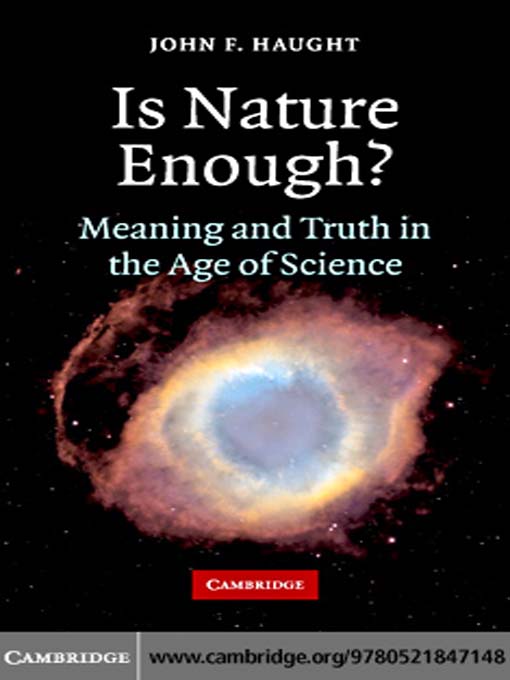
 In the interview that I published with Ulrich Mohrhoff, he suggested the reading of John Haught's book entitled "Is nature enough?". After having finished Haught's book, I must say that it is a very good book.
This book is philosophically sophisticated, scientifically very well informed and, still, very easy to read.
Readers interested in a rigorous, honest and serious critical examination of metaphysical naturalism, should get this book and study it carefully.
Crucial to the accurate understanding of contemporary pseudoskepticism is the insight and knowledge of the philosophical worldview that most "skeptics" take for granted and from which most of their criticisms against parapsychology, the afterlife and spirituality in general is ultimately based upon.
I highly recommend this book.
Sunday, May 29, 2011
Moderate Skeptic Chris French concedes that professional skeptics apply a worldview-induced double standard towards parapsychology
 Some self-proclaimed "skeptics", specially the dishonest, propagandistic and charlatanistic ones, like to disregard the influence that ideology (specially, the materialistic-naturalistic worldview) has on the evaluation of the evidence for psi. For these ignorant charlatans, the evidence for a given claim speaks for itself and in the case of psi, there is not evidence at all for such a thing. For them, any reference to "worldview" questions, in the debate about parapsychology, is a red herring. (Obviously, you don't need to be a philosopher of science to know that NO evidence speaks for itself; on the contrary, the evidence is always relative to the hypothesis or hypotheses being tested, or assumed, because a piece of evidence is evidence for or against some hypothesis, and cannot be understood as evidence without any explicit or implict reference to some hypothesis; moreover, its evaluation is done in terms of a conceptual and theoretical backgrounds and assumptions. And the latter are in many cases influenced and even determined by worldview considerations).
For example, essential to the naturalistic worldview is the principle of the causal closure of the physical world. In means that non-physical causation on the natural world is impossible. As consequence, God, spirits, souls, etc. (even if they exist) cannot be causally efficacious. For this reason, you can read in the leading propagandistic website for atheistic naturalism, infidels.org, a definition of the naturalistic worldview in terms of an affirmation of the causal closure and a DENIAL of souls or spirits: "The Secular Web is... an organization dedicated to promoting and defending a naturalistic worldview on the internet... Naturalism is the hypothesis that the natural world is a closed system , which means that nothing that is not part of the natural world affects it. Naturalism implies that there are no supernatural entities -including God" (emphasis in blue added).
Stressed in blue are the essential beliefs of naturalism:
1-It's a worldview (Note: the next time you see a naturalist or atheist denying that naturalism is a worldview, you'll know with full certainty that you're dealing with an intellectually dishonest, ignorant, stupid and sophistical charlatan, not worthy of intellectual respect).
2-The natural world is a closed system (hence, not non-natural/physical causes can be efficacious).
3-There is no God, or non-material spirits, souls, etc. So, naturalism implies ATHEISM.
Are the above worldview's doctrines relevant to the evaluation of some parapsychology's claims? Obviously they are, because some parapsychological claims are contrary to such naturalistic beliefs. Think for example of the efficacy of praying, or psychokinesis, or near-death experiences implying the separation of the soul from the body.
If you're a believer of naturalism, you have (a priori!) to deny at all cost the existence of all these things. A consistent naturalist is necessarily a critic of all of these things (regardless of the evidence), because his worldview demands such position. Any evidence in favor of these phenomena will be relativized, dismissed, undermined, interpreted uncharitably or simply ignored by the naturalist, but the evidence against these paranormal claims will be stressed, supported, interpreted charitably, or even invented, because his worldview demands such consistent double standard.
Chris Carter has been one of the few thinkers who have realized the importance of worldviews in the evaluation of the psi controversy (see his book Parapsychology and the Skeptics and his contribution to the book Debating Psychic Experience). Carter summarizes his case with this words: "I am convinced that the key to a rational resolution of this matter lies in realizing that this controversy is not primarily about evidence, but rather about competing worldviews." (Debating Psychic Experience, p.78. Emphasis in blue added).
I haven't seen any better insight regarding the core of the debate about parapsychology than Carter's.
Sophisticated "skeptics" know that Carter is right. They fully realize that in the evaluation of the evidence for psi, beliefs based on worldviews are important and even determinant. Some of these skeptics, explicitly, appeal to the current "scientific worldview" in order to deny the existence of psi or cast doubts on its probable existence.
In the book Debating Psychic Experience, self-proclaimed "moderate skeptic" Chris Franch concedes that there is exist a double standard regarding parapsychology and that such double standard is justified by worldview considerations. In French's words: "Several commentators (e.g., Edge et al., 1986) have quite rightly pointed out that, contrary to popular opinion, direct replications are quite rare in all areas of science, including psychology. Furthermore, many psychological effects reported in the literature have turned out to be difficult, sometimes impossible, to replicate. This often comes as a complete revelation to new postgraduate students who, having been raised upon a diet of practical classes based upon carefully chosen, very robust effects, are shocked to discover that often they cannot even replicate the basic effects that they intended to investigate in their own research. It is argued that it is therefore unfair to single out parapsychology as a discipline that has a particular problem in this respect. Is this another example of stricter standards being applied to parapsychology than to psychology? Indeed it is—but with good reason. In some important respects, the publication of an unreplicable effect in psychology simply matters less than it matters in parapsychology... Firstly, because in the fullness of time a few papers with negative results will be published—and many other experimenters will also have failed to replicate the effects but not bothered to write-up their results. Thus, word will spread along the informal networks of researchers in this area. It may take some time, but eventually it will be generally accepted that this particular interesting hypothesis is not valid. But secondly—and much more importantly—whether or not the hypothesis is valid, no radical revision of our existing scientific world view would be required. In the case of tests of the psi hypothesis, positive results would require exactly such a radical revision. It is therefore much more important that we establish whether or not the claimed effects are replicable... The crucial importance of reliably producing a convincing demonstration of even a tiny psi effect under well-controlled conditions is that to many scientists, myself included, this would require the kind of radical revision of worldview that would make at least some of the larger scale paranormal claims seem more plausible (p.57-59. Emphasis in blued added)
Let's examine French's contention in more detail:
1-He claims that the "scientific worldview" (?) is affected by the psi hypothesis. Therefore, the "scientific worldview" is not neutral regarding psi, but that it is incompatible with it (hence the necessity of radical revision, if psi were real).
This implies that a believer in the "scientific worldview" (?) will be, a priori, hostile to the evidence for psi and will use double standard in order to evaluate psi claims with the purpose of undermine its scientific value. (Note that it is the position of the conservative dogmatist, not of the truth seeker. The latter would never use a double standard based on his own uncritical assumptions regarding what is the current worldview in order to favor certain scientific claims over other scientific claims).
2-Point 1 refutes that objection of skeptical charlatans according to which any reference to "worldviews" in the debate about psi is a red herring, and that "only the evidence" counts for the failure of the acceptation of parapsychology.
3-French concedes that the problem of replicatibility affects all the fields of science, including psychology. Many effects reported as actually existent in the scientific literature are not replicable or haven't been replicated. Therefore, the objection that parapsychological claims are not replicable is irrelevant, at least as an objection specific and distintive of parapsychology as a science.
Note that this concession raised the following problem: If many accepted claims in science are not replicable (and in this respect similar to parapsychology, according to French), then how the hell do we know if the "scientific worldview" is based, at least in part, on many of such non-replicable scientific claims assumed to be true? French doesn't answer this question, because he doesn't mention exactly which are the assumptions or foundations of such "scientific worldview" and which replicable evidence supports it.
Exactly which scientific claims are part of the "scientific worldview"? And how many of these claims are replicable or have been actually replicated? And more importantly, exactly in which respect such scientific claims are incompatible with psi?
French doesn't expand on this crucial point of his argument. He simply assumes that psi, if it exists, is incompatible with the scientific worldview (?) and the latter would require a radical revision in order to accomodate psi. Period.
Again, this is not the position of a true skeptic (let alone a "moderate" one). This is the position of the conservative dogmatist, who assumes that there is just ONE scientific worldview or one interpretation of it (which?), that such worldview is based on scientific claims (replicable or non-replicable? or both? Which ones of these claims are relevant to psi?) and that such claims are incompatible with psi (how, exactly?).
Although "professional skeptics" almost never define or explicate which worldview they have in mind, all of us know their worldview is atheistic materialism/naturalism. They intentionally or unintentionally, conflate science with naturalism, and from there they call "unscientific" any claim which is contrary to the materialistic and naturalistic worldview (like praying, or healing at distance, for example)
I think Chris Carter is right: such atheistic worldview is based fundamentally in the (already refuted) Newtonian physics. They have not incorporated the new physics "quantum mechanics" in their worldview considerations.
As Dean Radin wrote in reply to French: "I will simply state that a radical revision in our worldview has already been with us for 80 years; but because that worldview presents such a radical departure from everyday common sense, it is only now beginning to penetrate into the awareness of the psychological sciences. The “new” worldview is based upon our most comprehensive understanding of the physical world to date, namely, quantum theory."(p.115)
Perhaps you're thinking that Radin is too biased in favor parapsychology, and hence he's misrepresenting quantum mechanics in order to make it fit with parapsychology.
Well, let's quote professional physicists and skeptics of psi Bruce Rozenblum and Fred Kuttner. In their book Quantum Enigma, in the section entitled "Paraphenomena", they wrote:
That widespread acceptance of paraphenomena is sufficient reason for including some comment in our book. A more important reason is that certain competent researchers claiming to display such phenomena cannot be dismissed out of hand. But hard-to-believe things require strong evidence. If someone tells you that there is a black dog outside, you likely just accept it. If they tell you there is a green giraffe, you want to go see for yourself. As yet, evidence for the existence of paraphenomena strong enough to convince skeptics does not exist.
But if — if!— such a phenomenon were convincingly demonstrated, we would know where to start looking for an explanation: the quantum effects of consciousness, Einstein’s “spooky interactions.” (p.192)
The reference to the view that no evidence sufficient to convince skeptics exists is revealing of the authors' strong skepticism (and ignorance of the best scientific literature about parapsychology). Hence, they're not biased in favor of parapsychology.
The reference to the explanation of these phenomena (if they were proved to exist) based on quantum effects of consciousness, reveals that (contrary to French and other professional skeptics' misleading and pseudoscientific speculations) no radical revision of our scientific worldview is needed. Contemporary science, specially best tested scientific theory, namely quantum physics, provide a theoretical framework to explain these phenomena.
The evidence for psi is incompatible with naturalism and materialism, but not with science.
Don't let yourself be fooled by atheistic ideologues into the idea that science and atheistic naturalism are the same (or that science implies a naturalistic worldiview, as defined by the infidels.org website).
Don't let yourself be fooled by atheistic ideologues into the idea that science and atheistic naturalism are the same (or that science implies a naturalistic worldiview, as defined by the infidels.org website).
Subscribe to:
Posts (Atom)