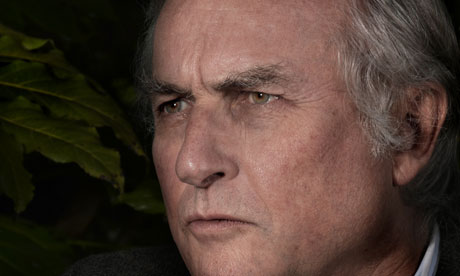
Showing posts with label Richard Dawkins. Show all posts

Sunday, November 25, 2012

Richard Dawkins vs Karen Armstrong debate on God and Dawkins' objection to skeptic Michael Shermer's Last Law. Who's the greatest and brilliantest atheistic thinker?


Michael Shermer is a well-known skeptical writer. One of the reasons why he so well-known is by being debunked in his own TV debunking program by master of Eastern Wisdom and vedic astrologer Jeffrey Armstrong, who passed sucessfully Shermer's skeptical test, as you can watch here:


The results of Shermer's test with Armstrong implies one of the following possibilities:

-Armstrong is a fake psychic/astrologer/paranormalist, and he passed Shermer's test because he fooled Shermer. In this hypothesis, Shermer is an incompetent scientist and skeptic, who is unable to design correctly a scientific test in which no fraud can be made. This incompetence is even more objectionable, since his Tv program was designed to promote skepticism and exemplify proper controls while testing paranormal claims.

-Armstrong is a true astrologer with paranormal knowledge, in whose case Shermer's skepticism regarding the paranormal has been refuted. In this case, Shermer is not being intelelctually honest in admitting this, and he's misleading the public about  the paranormal.

-Armstrong is fake but he passed the test just because he had luck. In this case, intellectual honesty demands that Shermer tests Armstrong again, something which Shermer didn't dared to do. Moreover, if a single test is inconclusive, then the same can be said of the other single tests made by Shermer in which negative results for paranormal claims were gotten (otherwise, an unscientific double standard would be being applied in order to favor the skeptical position).

By the purpose of this post is not to evaluate Shermer's pseudoskepticism. Rather, I'm interested in Shermer as a thinker or intellectual. I've commented before that, in my humble opinion, Shermer is the less sophisticated and most crude thinker among  professional"skeptics". He tries to look like an expert in everything (from spiritualism, to UFOs, to alternative medicine, to parapsychology, to biblical criticisms and New Testament scholarship, to religion, etc.), but he deals with them in a very superficial level. 

For example, in a previous post, I discussed about the so-called Shermer's Last Law, which states "Any sufficiently advanced extraterrestrial intelligence is indistinguishable from God"

Shermer's law is amazingly inept, and it is telling of the point I'm making about him. Even the crudest atheists will realize this.

One of such atheists is Richard Dawkins. In his written debate with religious pluralist Karen Armstrong, Dawkins wrote this:

But, however god-like the aliens might seem, they would not be gods, and for one very important reason. They did not create the universe; it created them, just as it created us. Making the universe is the one thing no intelligence, however superhuman, could do, because an intelligence is complex—statistically improbable —and therefore had to emerge, by gradual degrees, from simpler beginnings: from a lifeless universe—the miracle-free zone that is physics.

Even such an crude thinker like Dawkins realizes that whichever other properties we posit to "God", one of such essential properties is being the CREATOR of the material universe. In fact, the most sophisticated and discussed philosophical argument for God's existence is precisely the kalam cosmological argument for the universe's beginning and putative creation:


Since an essential property of God, if He exists, is that He is the creator of the material universe; and since it is NOT essential to the concept of advanced aliens to be the creators of the material universe (because, among other things and presumibly atheists will agree, aliens are material beings who are the product and effect of a material universe), it follows that that, contrary to Shermer's Law, God is conceptually distinguishable from advanced aliens.

So, Dawkins' point, despite of its intellectual crudity, is correct: Shermer's Law is false.

The above point underlies my initial contention about Shermer: Intellectually, he is even below crude atheists like Richard Dawkins. What is obvious to even intellectually unsophisticated thinkers is far beyond the reach of Shermer.

You can watch Shermer's crudity at its best in his debate about God's existence with John Lennox:


Regarding the debate between Dawkins and Armstrong, I was dissapointed by Armstrong's arguments (some of which were self-refuting) and not much need to be added to the exchange between them.

Sunday, December 18, 2011

The great debate: Richard Dawkins vs John Lennox


[DEBATE] Deus, Um Delírio: O Debate - Richard Dawkins & John Lennox from Deus em Debate on Vimeo.

In my opinion, Lennox clearly destroyed Dawkins in this debate pretty easily. In fact, some people suspect that Dawkins' coward refusal to debate William Lane Craig was caused, in part, by the beating that Lennox provided to him. Dawkins realized that, if Lennox destroyed him in public, Craig (who's a more experienced debater) would sweept the floor with him.

Currently, Dawkins has received a new debating challenge from Patrick Coffin, to debate with Christian philosopher Edward Feser (the author of Aquinas and the The Last: Superstition: a Refutation of the New Atheism). This challenge will prove again Dawkins' cowardice, because he WON'T accept.

And if he accepts, then we will enjoy a new intellectual beating of Dawkins.

Tuesday, November 8, 2011

Is God a Delusion? The Debate That Never Was: William Lane Craig vs Richard Dawkins? Sheldonian Theatre, Oxford (October 25, 2011)


Richard Dawkins was invited by the Oxford student Christian Union to defend his book The God Delusion in public debate with William Lane Craig. The invitation remained open until the last minute. However, Dawkins refused the challenge and his chair remained empty. Craig then gave a lecture to a capacity audience on the weaknesses of the central arguments of the book and responded to a panel of skeptical academics. The event, which was chaired by atheist Prof. Peter Millican, was part of The Reasonable Faith Tour 2011 sponsored by UCCF, Damaris & Premier Christian Radio.

Saturday, November 5, 2011

Why is there something rather than nothing? Intellectual genius Richard Dawkins responds the fundamental question of philosophy!


To be fair, you have to realize that Richard Dawkins is not a philosopher, he's a zoologist. So, Dawkins' response is completely out of his intellectual training and expertise.

What is astonishing to me is that Dawkins has not been able to recognize the fallacy of his answer (It suggests either intellectual dishonesty or simply stupidity on his part, or both). He seems to believe that has gotten a knock-down argument against the existence of God (or God as an explanatory hypothesis).

Oxford Atheist philosopher Daniel Came (being academically trained in philosophy) comments on Dawkins' main argument (which he repeats in the above video in a modified version in order to response the fundamental question of philosophy):

Dawkins maintains that we're not justified in inferring a designer as the best explanation of the appearance of design in the universe because then a new problem surfaces: who designed the designer? This argument is as old as the hills and as any reasonably competent first-year undergraduate could point out is patently invalid. For an explanation to be successful we do not need an explanation of the explanation. One might as well say that evolution by natural selection explains nothing because it does nothing to explain why there were living organisms on earth in the first place; or that the big bang fails to explain the cosmic background radiation because the big bang is itself inexplicable.

As Came's realizes, if Dawkins' argument were correct, then:

-Natural selection explains nothing because it doesn't explain why there were living organisms on earth in the first place.

-The big bang theory explains nothing because the big bang itself doesn't have any explanation.

I'd add the following couple of examples:

1-In 1983/84, when HIV was discoveried and the HIV theory of AIDS was formulated, the origin of HIV was unknown and hence unexplained. Therefore, the HIV theory of AIDS explains nothing! Or to use Dawkins' phraseology and stupid way of thinking: "Even if HIV were postulated to exist, it doesn't explains absolutely anything because you left without an explanation of HIV itself." (Is it a good scientific or philosophical objection to the HIV theory of AIDS? Do you need an explanation of HIV itself in order to conclude, if the evidence is good, that HIV is the "probable cause of AIDS" as Robert Gallo declared in 1984? Obviously not. Only atheists like Dawkins and his "fans" would accept such an intellectually ridiculous and spurious objection, what tell us something about the psychology of atheists and their intellectual powers).

2-After his debate with John Lennox, Dawkins was interviewed and asked about the origin of life on Earth. Dawkins reportedly said that "he was more receptive to the theory that life on earth had indeed been created by a governing intelligence – but one which had resided on another planet."

Now, using Dawkins' own assumptions in his argument against God, we could say "Dawkins, your alien creationist hypothesis doesn't explain absolutely anything because the aliens in question remain themselves unexplained"

Reflecting hard and in a charitable way about Dawkins' argument, I've concluded that Dawkins is stupid in the literal sense of the word (stupid = very dull in mind). He's simply incapable of sophisticated intellectual thinking and even of recognizing obvious fallacies. He's stupid. (And by extension, I assume until proved wrong that most of Dawkins' "fans" are stupid too, because it is irrational and stupid to be an intellectual fan of an intellectually stupid person).

I've found a similar stupidity in other atheists (remember the "What caused God" objection posed by some of them against the cosmological argument), and this "atheistic stupidity pattern" strongly suggest something about the psychology of hard-core atheists. This why currently I'm convinced that hard-core atheists have a kind of intellectual and cognitive impairment, which makes them incapable of thinking rationally.

Their intelligence only reach to the most superficial level on difficult topics.

I'll comment more on the psychology of atheists in future posts.

Richard Dawkins supports infanticide of innocent babies with incurable diseases


Tuesday, November 1, 2011

Richard Dawkins says that rape is morally arbitrary


The transcript:

Justin Brierley: When you make a value judgement don't you immediately step yourself outside of this evolutionary process and say that the reason this is good is that it's good. And you don't have any way to stand on that statement.

Richard Dawkins: My value judgement itself could come from my evolutionary past.

Justin Brierley: So therefore it's just as random in a sense as any product of evolution.

Richard Dawkins: You could say that, it doesn't in any case, nothing about it makes it more probable that there is anything supernatural.

Justin Brierley: Ultimately, your belief that rape is wrong is as arbitrary as the fact that we've evolved five fingers rather than six.

Richard Dawkins: You could say that, yeah.

End of the transcript.

Compare with naturalist and philosopher of biology Michael Ruse:

The position of the modern evolutionist is that humans have an awareness of morality because such awareness is of biological worth. Morality is a biological adaptation no less than hands and feet and teeth. Considered as a rationally justifiable set of claims about an objective something, ethics is illusory. Michael Ruse, The Evolutionary Theory and Christian Ethics, in the Darwinian Paradigm (pp. 262-269. Emphasis in blue added.)

Or naturalist and philosopher of biology Alex Rosenberg: "One source of meaning on which many have relied is the intrinsic value, in particular the moral value, of human life. People have also sought moral rules, codes, principles which are supposed to distinguish us from merely biological critters whose lives lack (as much) meaning or value (as ours)... Scientism must reject all of these straws that people have grasped, and it’s not hard to show why. Science has to be nihilistic about ethics and morality. Alex Rosenberg, in his article "The Disenchanted Naturalistic Guide to Reality". Emphasis in blue added.

Monday, October 31, 2011

The dangerous ideas of Richard Dawkins: Irrefutable proof that Dawkins' refusal to debate Craig is not only coward but intellectually dishonest


In 2006, the magazine Edge published a series of articles with leading scientists and scholars on the question What's your dangerous idea?

Richard Dawkins was one of the "scholars" to whom such a question was asked. Let's copy here the entire article (in order to avoid misrepresentations of Dawkins' view). Please, read carefully the full article, specially the emphasis in blue added by me. (You can consult the original article in the Edge website here). I'll prove, with irrefutable evidence (in the context of Dawkins' excuses to avoid debating William Lane Craig) that Richard Dawkins is not only a COWARD but that, additionally, his refusal to debating Craig is based on reasons which Dawkins himself see as scientifically false.

People like Dawkins deserve to receive public intellectual punishment (i.e. sound refutations of his charlatanisms) and an evidence based debunking.

Let's all stop beating Basil's car
by Richard Dawkins

Ask people why they support the death penalty or prolonged incarceration for serious crimes, and the reasons they give will usually involve retribution. There may be passing mention of deterrence or rehabilitation, but the surrounding rhetoric gives the game away. People want to kill a criminal as payback for the horrible things he did. Or they want to give "satisfaction' to the victims of the crime or their relatives. An especially warped and disgusting application of the flawed concept of retribution is Christian crucifixion as "atonement' for "sin'. Retribution as a moral principle is incompatible with a scientific view of human behaviour. As scientists, we believe that human brains, though they may not work in the same way as man-made computers, are as surely governed by the laws of physics. When a computer malfunctions, we do not punish it. We track down the problem and fix it, usually by replacing a damaged component, either in hardware or software. Basil Fawlty, British television's hotelier from hell created by the immortal John Cleese, was at the end of his tether when his car broke down and wouldn't start. He gave it fair warning, counted to three, gave it one more chance, and then acted. "Right! I warned you. You've had this coming to you!" He got out of the car, seized a tree branch and set about thrashing the car within an inch of its life. Of course we laugh at his irrationality. Instead of beating the car, we would investigate the problem. Is the carburettor flooded? Are the sparking plugs or distributor points damp? Has it simply run out of gas? Why do we not react in the same way to a defective man: a murderer, say, or a rapist? Why don't we laugh at a judge who punishes a criminal, just as heartily as we laugh at Basil Fawlty? Or at King Xerxes who, in 480 BC, sentenced the rough sea to 300 lashes for wrecking his bridge of ships? Isn't the murderer or the rapist just a machine with a defective component? Or a defective upbringing? Defective education? Defective genes? Concepts like blame and responsibility are bandied about freely where human wrongdoers are concerned. When a child robs an old lady, should we blame the child himself or his parents? Or his school? Negligent social workers? In a court of law, feeble-mindedness is an accepted defence, as is insanity. Diminished responsibility is argued by the defence lawyer, who may also try to absolve his client of blame by pointing to his unhappy childhood, abuse by his father, or even unpropitious genes (not, so far as I am aware, unpropitious planetary conjunctions, though it wouldn't surprise me). But doesn't a truly scientific, mechanistic view of the nervous system make nonsense of the very idea of responsibility, whether diminished or not? Any crime, however heinous, is in principle to be blamed on antecedent conditions acting through the accused's physiology, heredity and environment. Don't judicial hearings to decide questions of blame or diminished responsibility make as little sense for a faulty man as for a Fawlty car? Why is it that we humans find it almost impossible to accept such conclusions? Why do we vent such visceral hatred on child murderers, or on thuggish vandals, when we should simply regard them as faulty units that need fixing or replacing? Presumably because mental constructs like blame and responsibility, indeed evil and good, are built into our brains by millennia of Darwinian evolution. Assigning blame and responsibility is an aspect of the useful fiction of intentional agents that we construct in our brains as a means of short-cutting a truer analysis of what is going on in the world in which we have to live. My dangerous idea is that we shall eventually grow out of all this and even learn to laugh at it, just as we laugh at Basil Fawlty when he beats his car. But I fear it is unlikely that I shall ever reach that level of enlightenment.

Jime's conclusions:

1)Dawkins claims that according to science human brains "are as surely governed by the laws of physics" and hence the concept of "retribution" is unscientific. Therefore, "punishment" makes no sense at all (Dawkins: "When a computer malfunctions, we do not punish it.")

Such a view implies DETERMINISM (i.e. the view that human thinking and actions are wholly determined by physical laws, not freedom of the will is allowed).

True, naturalism implies such view on determinism, but wait a minute. Think about it: If determinism is true, then Dawkins' belief in determinism is ALSO determined by physical laws, not by reason or logic (which are no physical laws). Dawkins is a determinist because physical laws impose on him such a belief, not because such a belief is rationally justified over other non-jusitified beliefs.

So, as we never say that a computer is irrational when it malfunctions (because such computer is not guilty of the malfunctioning due to the deterministic physical laws which controls it), we cannot say that human beings (e.g. religious fundamentalists) are irrational when they have false beliefs or do dangerous actions. After all, like the computer, human beings are fully determined (by physical laws) in their functioning (reason and logic, not being physical laws, don't determine anything), and the concepts of rational or irrational makes no sense.

Moreover, on what grounds are you going to criticize religious people who believe in God, free will, the afterlife, spirits and indeterminism, if their beliefs are ALSO determined by the same physical laws which impose on Dawkins his deterministic view?

The same physical laws which makes Dawkins an automata without free will will be efficacious to make all the other people automata too. And the difference of beliefs of each person will be caused by physical laws, not by the person' fault, and hence you cannot complain that such people are irrational or guilty, since they have not responsability at all regarding the beliefs they hold.

2)Dawkins claims that "evil and good" are MENTAL CONSTRUCTS and USEFUL FICTIONS (i.e. they exist in our minds alone), and don't have any objective, mind-independent existence. In Dawkins word's: "Presumably because mental constructs like blame and responsibility, indeed evil and good, are built into our brains by millennia of Darwinian evolution. Assigning blame and responsibility is an aspect of the useful fiction of intentional agents that we construct in our brains as a means of short-cutting a truer analysis of what is going on in the world in which we have to live. My dangerous idea is that we shall eventually grow out of all this and even learn to laugh at it"

Note that Dawkins constrast such a mental constructs and fictions with the "truer analysis of what is going on in the world", which implies that such mental constructs and fictions are probably FALSE.

Again, this view is entailed by metaphysical naturalism and atheism, so Dawkins is (at least in this point) being consistent.

Now, if the "evil" is a mental construct which a scientific atheist should deny (on behalf of a more rational and true scientific analysis), then WHY THE HELL DID DAWKINS SAY THAT WLLIAM LANE CRAIG'S THEOLOGY IS EVIL? On that objective moral grounds is Dawkins going to criticize Craig if such a moral ground is a pure mental construct without any objective validity? Moreover, is Craig guilty of something "evil" when, according to Dawkins' beliefs, the evil doesn't exist and Craig is fully determined in his beliefs and actions by the same deterministic physical laws which determine Dawkins' beliefs and actions?

This is evidence which Dawkins doesn't take his worldview seriously. He denies the objective existence of the "evil", but then accusses others (specially religious believers) of being evil or of doing evil things.

He denies the justification of the concept of "retribution and punishment", but then castigates Craig when the latter defends a religious view that Dawkins finds unpalatable.

He criticizes (and uses as an excuse to refuse debating) Craig by his (alleged) justification of biblical genocide, but Dawkins himself claims that he is open to the persuasion that "killing people is right under certain circunstances" (so, supporting genocide).

Do you think the evidence mentioned here support the conclusion that Dawkins is a rational, logical and intellectually honest scholar?

I think the answer is obvious. As I said, in my opinion, people like Dawkins deserve to receive a public exposing and evidence-based intellectual punishment (=solid refutations of his views), and in this blog I'll contribute to this purpose.

I entirely agree with atheist Oxford philosopher Daniel Came who says that Dawkins's refusal to debate Craig is cynical and anti-intellectualist, and that people like Dawkins "seek to replace one form of irrationality with another."

Sunday, October 30, 2011

As expected and predicted Richard Dawkins didn't appeared to debate William Lane Craig


The above is a video by a Christian youtuber called (in youtube) . He made a good work putting together some of the pictures of the Oxford scholarly meeting to discuss Craig's lecture on Dawkins' book The God Delusion.

As the coward Richard Dawkins didn't showed up, Craig was confronted with a panel of 3 skeptical scholars (including atheist philosopher Daniel Came, who called Dawkins a coward and an anti-intellectual) who made critical comments of Craig's lecture, followed by Craig's response. It seems the session also included questions by the audience.

This kind of intellectual interaction is good and productive, because it enables to see the force and weaknesses of the arguments of each side.

High level intellectual debates like this are much appreciated by seekers for the truth (people like Richard Dawkins and many pseudoskeptical charlatans don't like that kind of debates, because the extreme weaknesses, superficiality and sophistical character of their case is fully exposed in front of the public).

Stay tuned for the video and audio of this interesting Oxford session.

Friday, October 28, 2011

Rabbi Moshe Averick defends William Lane Craig against atheist Richard Dawkins and calls him a "chicken" for dodging a debate with Craig

Rabbi Moshe Averick is an ordained Orthodox Rabbi who has taught theology, spirituality, and religious philosophy for nearly 30 years


Read Averick's article here.

Sunday, October 23, 2011

Oxford historian Tim Stanley says that Richard Dawkins is either a fool or a coward for refusing to debate William Lane Craig


Dr Tim Stanley is a research fellow in American History at Oxford University. He is currently working on a biography of Pat Buchanan.

In a recent article, Dr.Stanley says:

We are left with two possible conclusions from Richard Dawkin’s flimsy sick note. The first is that he doesn’t understand Christian apologetics, which is why he unintentionally misrepresents Craig’s piece. The most frustrating thing about the New Atheism is that it rarely debates theology on theology's own terms. It approaches metaphor and mysticism as if they were statements of fact to be tested in the laboratory. Worse still, it takes the crudest equations of faith (total submission to an angry sky god) and assumes that they apply to all its believers at all times equally. That most Christians living in the 21st century don’t know who the Canaanites were and only go to church because it brings them an intangible inner peace, totally escapes these atheist pedants.

The second explanation is that Dawkins is a coward. He likes to pick fights either with dunces (like the deliciously silly and obviously gay Ted Haggard) or with incredibly nice old Christians with no fire in their belly (like Rowan Williams). Dawkins has gotten away with his illiterate, angry schtick for so many years because his opponents have been so woolly. This is a damning indictment not only of him, but of the clerical establishment of Great Britain. But this time, he understood that he was up against a pro. In America, evangelicals have to compete in a vibrant, competitive marketplace of different denominations. That breeds the very guile and theatricality that are so sorely lacking among the Anglican clergy. In Craig, Dawkins met his match. Like Jonah, he was confronted by the truth and he ran away.

It seems that Dawkins' cowardice (as evidenced by his refusal to debate God's existence with Craig) is being well known and widespread among Oxford scholars (both theists and atheists alike, see an example of the latter here).

Saturday, October 22, 2011

Atheist philosopher Daniel Came says that Richard Dawkins's refusal to debate William Lane Craig is cynical and anti-intellectualist


In this recent article, an atheist philosopher from Oxford named Daniel Came argues that Richard Dawkins' refusal to debate William Lane Craig is cynical and anti-intellectualist and adds that such position is typical of the so-called New Atheists.

Dr.Came comments:

Richard Dawkins is not alone in his refusal to debate with William Lane Craig. The vice-president of the British Humanist Association (BHA), AC Grayling has also flatly refused to debate Craig, stating that he would rather debate "the existence of fairies and water-nymphs".

Given that there isn't much in the way of serious argumentation in the New Atheists' dialectical arsenal, it should perhaps come as no surprise that Dawkins and Grayling aren't exactly queuing up to enter a public forum with an intellectually rigorous theist like Craig to have their views dissected and the inadequacy of their arguments exposed.

Came's article is a reply to Dawkins' recent article where he poses another silly excuse to avoid debating William Lane Craig.

I haven't read any professional paper or book by Dr.Came, but given his straightforward position regarding Dawkins' obvious cowardice, dishonesty and anti-intellectualism, I must assume that Came is an intellectually honest atheist. This kind of atheist is worthy of respect and admiration, even if you disagree with him (regarding their atheistic worldview).

Moreover, as a trained and competent philosopher, Came castigates Dawkins' fallacious arguments against theism. In Came's words: "Dawkins maintains that we're not justified in inferring a designer as the best explanation of the appearance of design in the universe because then a new problem surfaces: who designed the designer? This argument is as old as the hills and as any reasonably competent first-year undergraduate could point out is patently invalid. For an explanation to be successful we do not need an explanation of the explanation. One might as well say that evolution by natural selection explains nothing because it does nothing to explain why there were living organisms on earth in the first place; or that the big bang fails to explain the cosmic background radiation because the big bang is itself inexplicable."

Note that Came's objection to Dawkins's argument is exactly the same objection that William Lane Craig has raised against Dawkins:


This is evidence of intellectual honesty and rigour by Came. (You can see that, contrary to the very common atheistic cranks, irrationalists and charlatans, there are a few atheists out there who are intellectually honest and competent thinkers, worthy of intellectual respect and admiration).

Just for the record (and as a personal addendum): In his article, Richard Dawkins says that he won't debate Craig because Craig is an "apologist for genocide". A smart (and hypocritcal, as we will see) excuse by Dawkins, indeed.

That excuse by Dawkins provides more evidence of his intellectual dishonesty, sophistry and personal cowardice (giving support to Dr.Came, who suggested in a previous article that Dawkins is a COWARD).

Consider the evidence:

Dawkins poses an apparently "moral reason" (the alleged defense of genocide by Craig) as a valid excuse to avoid debating Craig. However, the hypocrital and coward Dawkins himself is sympathetic ("quite open") to the persuasion that the murdering and killing of human beings is right. In this interview, Dawkins says: "Now, if you then ask me where I get my 'ought' statements from, that's a more difficult question. If I say something is wrong, like killing people, I don't find that nearly such a defensible statement as 'I am a distant cousin of an orangutan... The statement 'killing people is wrong', to me, is not of that character. I would be quite open to persuasion that killing people is right in some circumstances... I couldn't, ultimately, argue intellectually against somebody who did something I found obnoxious. I think I could finally only say, "Well, in this society you can't get away with it" and call the police... I realise this is very weak, and I've said I don't feel equipped to produce moral arguments in the way I feel equipped to produce arguments of a cosmological and biological kind" (Emphasis in blue added).

Now, on what moral grounds is Dawkins going to criticize Craig' (alleged) endorsement of genocide, if in Dawkins' own view the statement "killing people is wrong" or "genocide is wrong" or "killing people is right in some circunstances" cannot be defended rationally and intellectually?

Moreover, for Dawkins, "killing people" is not morally evil or bad because in his own opinion the evil doesn't exist objectively in this universe. In his work River Out Of Eden, Dawkins wrote: "The universe we observe has precisely the properties we should expect if there is, at bottom, no design, no purpose, no evil and no good, nothing but blind, pitiless indifference." (p.155. Emphasis in blue added)

So, the "observable universe" (which includes the observable cases of murder, rape, genocide, terrorism, poverty, drug additcion, frauds, bigotry and persecution against atheists, etc.) is not, at the bottom, "evil" at all for Dawkins, then which is the rational and intellectual basis of Dawkins' moral complain against Craig? Is Craig being "evil" in Dawkins' view? Can Dawkins argue that Craig is defending something morally wrong and evil, and at the same time to claim that the evil doesn't exist in this universe?

The above suffices to prove that Dawkins is an intellectually incompetent, dishonest sophist and a straightforward coward atheist.

Consistent with his stupidity, incoherence and cowardice, Dawkins ask "Would you share a platform with him? I wouldn't, and I won't."

But Dawkins DID shared a plataform with Craig in Mexico some time ago, as you can watch in this video:


And as you can watch in that video, Dawkins' replies to Craig were ignorant, stupid and intellectually inept (which is typical of most atheists, according to my experience).

You can agree or disagree with Craig's arguments; but I think any rational person would easily see that Dawkins is an intellectual lightweight amateur in comparison with Craig (just compare the logical structure, rigour and coherence of the argumentation of both men).

Craig would destroy Dawkins very EASILY in a debate about God's existence. Dawkins knows it and this is the ACTUAL reason why Dawkins WON'T debate Craig. Ever.

Monday, October 17, 2011

Richard Dawkins and the The Magic of Hypocrisy and Cowardice (Making Money Missing The William Lane Craig Bus)


William Lane Craig's refutation of Richard Dawkins' arguments against the traditional arguments for God's existence:

BBC Oxford News- There's Probably No Richard Dawkins (Buses); On Dawkins's refusal to debate William Lane Craig


Saturday, September 10, 2011

Leading British Atheists (Polly Toynbee, Richard Dawkins & A.C. Grayling) cowardly run from William Lane Craig


Dawkins is not the only culprit in shying away from Craig's October 2011 UK Tour. He is but one of a Humanist Trinity who have all, in their own way, run away from William Lane Craig's willingness for open dialogue.

More on atheist cowardice regarding the debates with William Lane Craig, here, here and here.

Wednesday, September 7, 2011

Atheist philosopher from Oxford Daniel Came suggests that Richard Dawkins' refusal to debate Craig may be interpreted as cowardice on Dawkins' part

Dr.Daniel Came

According to this note, Dr Daniel Came, a philosophy lecturer and fellow atheist, from Worcester College, Oxford, wrote to Richard Dawkins urging him to reconsider his refusal to debate the existence of God with Christian philosopher and theologian Dr.William Lane Craig.

In a letter to Prof Dawkins, Dr Came said: “The absence of a debate with the foremost apologist for Christian theism is a glaring omission on your CV and is of course apt to be interpreted as cowardice on your part.

“I notice that, by contrast, you are happy to discuss theological matters with television and radio presenters and other intellectual heavyweights like Pastor Ted Haggard of the National Association of Evangelicals and Pastor Keenan Roberts of the Colorado Hell House.”

Came's reference to the intellectual "heavyweights" is clearly a joke, since pastors like Haggard and others are not the best defenders of Christian theism. Came is clearly trying to push Dawkins to accept the challenge to debate with the most sophisticated philosophical defender of God's existence, instead of arguing with common Christian pastors.

The leading contemporary defender of God's existence is William Lane Craig. So, any person who wants to argue against God's existence, has the intellectual duty to refute Craig's arguments for God's existence.

Dawkins, fully knowing that Craig would sweep the floor with him in an public and high-level intellectual debate, is avoiding the debate with Craig at all cost.

Personally, and being very familiar with the typical hard-core atheist's mindset (which includes arrogance + egotism + dishonesty + cowardice), I'm pretty sure that Dawkins WON'T debate Craig. Ever.

Richard Dawkins is demostrably a coward who is scared of dabating with William Lane Craig about God's existence


Wednesday, June 15, 2011

William Lane Craig, Richard Dawkins and the Empty Chair: An intellectual and scholarly challenge in Oxford that Dawkins will never take


Will Richard Dawkins finally engage in a scholarly one-to-one discussion with William Lane Craig when he visits Oxford? It would appear not, and even some fellow atheists seem to think he's making a big mistake. This is the story, so far, but what will come next?

Related posts on Dawkins:

-Richrad Dawkins on atheistic morality.

-Richard Dawkins' pseudoskepticism and bigotry.

-William Lane Craig's challenge to debate Dawkins (and the latter's refusal).

-Victor Zammit on Dawkins' view on the afterlife.

Sunday, May 15, 2011

According to Tim Ross of the telegraph.co.uk: Richard Dawkins accused of cowardice for refusing to debate existence of God with William Lane Craig

You can read the full story here. A couple of excerpts:

A war of words has broken out between the best selling author of The God Delusion, and his critics, who see his refusal to take on the American academic, William Lane Craig, as a “glaring” failure and a sign that he may be losing his nerve

He told The Daily Telegraph that he had recently debated Prof Craig, in a boxing ring, in Mexico, and claimed he was not impressed by his opponent. His critics say this event was a six-person discussion, not a rigorous debate, but Prof Dawkins disagrees.


Prof Craig, however, remains willing to debate with Prof Dawkins. “I am keeping the opportunity open for him to change his mind and debate with me in the Sheldonian Theatre in Oxford” in October, he said.

You need to read the full story, so please go to the link.

WHY IS IT LIKELY THAT DAWKINS WON'T DEBATE CRAIG:

As part of my research for the best arguments and evidence for metaphysical naturalism which I began many years ago, I found that Christians philosophers were the most effective critics of naturalism and atheistic materialism. The reason is that metaphysical naturalism is mostly a denial of Christianity. It is almost entirely based on an intense hostility and animosity towards Christianity (for my astonishment as a non-Amerian person and as non-Christian myself, I've discoveried that in USA and Canada, this hostility is shared by many spiritualists and people sympathetic to the "paranormal" too, who essentially use the same fallacious atheistic arguments! I'm in process of researching why is this the case... but this is another topic). Therefore, Christian philosophers have been forced to refine their arguments, while finding holes and flaws in the naturalist worldview.

William Lane Craig is a seasoned debater and leading defender of Christianity in the world today. For more than 20 years, he has debated the leading and most famous atheists in the world (people like Anthony Flew, San Harris, Lewis Wolpert, A.C. Greyling, Quentin Smith, Christopher Hitchens and many many others).

What was shocking for me was to discover that Craig would win easily all or most of these debates. And I found the atheists using crude, philosophically unsophisticated objections, defending absurdities, contradicting each other, making surprising concessions, contradicting their own published work, and sometimes using obvious logical fallacies (for an example, see my post on Craig's debate with Lawrence Krauss).

This was an eye opener to me, because if the best ideologues of materialism and naturalistic atheism cannot defend coherently their position when facing a Christian, then something seriously weird is happening here. Either naturalism is extremely weak, or the naturalists are monumnetally incompetent defenders of the naturalistic ideology.

My conclusion, so far, is that naturalism is false, and you cannot defend a falsehood in a coherent fashion. This is the secret behind Craig's success in his debates. For a trained philosopher like him, it is relatively easy to win his debates when debating naturalistic atheists. (I'm not implying that Christianity is false, and Craig's case for it is weak: If Christianity is false or not, depends largely on the topic of Jesus' Resurrection as being an historical fact, which is largely a controversial topic which I'm in process of researching right now).

My point is simply that Craig's strategy works fine against naturalistic and materialistic atheists, because they have not the philosophical resources to defend their position coherently.

And this is why I think that Richard Dawkins won't debate Craig. Dawkins fully knows that his case for atheism is philosophically weak, and that such case is convincing only for already convinced atheists or "agnostics" sympathetic to materialism.

Do you dare to debate Dawkins regarding zoology? Unless you're a trained zoologist, or an amateur with extensive knowledge of it, you would be stupid to pretend to cross swords with Dawkins in a topic of his speciality. You have to be aware of your own limitations.

Likewise, would Dawkins be so stupid as to cross swords with a philosopher and theologian like Craig in the latter's own field of speciality, namely, the arguments for God's existence? Obviously not. Dawkins fully knows that he won't win a debate with Craig regarding this topic.

Is Dawkins a coward? Previously, I've thought that he is. But now, I think his position is reasonable from a strategical point of view. This is a smart position. Why should Dawkins to expose himself to be kicked in the butt publicly? This doesn't make any sense.

So, I conclude that Dawkins won't debate Craig, and he's smart to do that.

PROPOSAL FOR A DEBATE WITH CRAIG THAT RICHARD DAWKINS WOULD POSSIBLY ACCEPT:

But contrary to other critics of Dawkins (I myself count as a critic of him), I think Dawkins would accept a debate with Craig if the topic is another: Darwinism vs. Intelligent Design. This is a topic which is part of Dawkins' own field of specialization, so there is not reason why he could think that Craig would win.

Does Craig would accept to debate that topic with Dawkins? I don't know, but I suspect that he would. Why? Because Craig has debated about Darwinism and Intelligent Design with biologists defenders of Darwinism (see Craig's debate with Francisco Ayala).

So, I propose a debate between Dawkins and Craig regarding the following topic: Is Intelligent Design in biology a viable alternative to Neo-Darwinism?

I see no reason why Dawkins would reject such debate, in fact perhaps he will be eager to take Craig in this topic!

Monday, January 4, 2010

Where Richard Dawkins goes wrong on his argument for the improbability of God by professor of philosophy Alvin Plantinga

Where Richard Dawkins goes wrong from CPX on Vimeo.

Sunday, January 3, 2010

Who Designed The Designer? a response to Richard Dawkins' The God Delusion by Dr. William Lane Craig

 
ban nha mat pho ha noi bán nhà mặt phố hà nội